Published on Tuesday, 11 August 2026, 11:00.
A smart home sounds like comfort: the TV streams, the speaker does what it’s told, the camera reports movement, the console downloads updates and the robot vacuum knows the flat better than some visitors. Practical? Yes. Clear? Not always.
Because every connected device regularly establishes connections to the outside world. Often this happens in the background. Users can’t see which services are contacted, which telemetry is transmitted or which tracking systems are running alongside. This is exactly where smart home DNS protection is becoming more and more important.
It is not about making people afraid of technology. It is about taking back a bit of control. Without laboriously checking each individual device. And without turning the living room into a server lab.
Why smart home devices establish so many connections
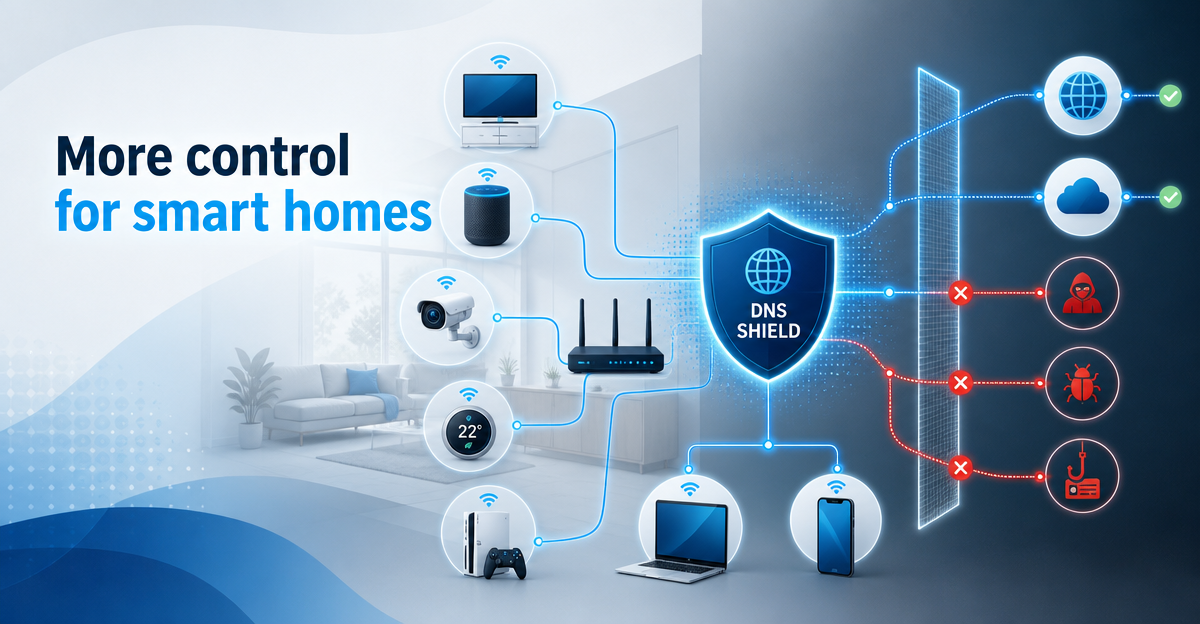
Smart TVs, cameras, thermostats, speakers, consoles and household appliances are small computers today. They look for updates, synchronise settings, load content, check licences or send diagnostic data to manufacturer services.
That isn’t automatically bad. Many connections are necessary for devices to work. The problem is: for ordinary users it is hardly possible to tell which connections make sense and which lean more towards advertising, tracking or questionable services.
Industry reports and privacy studies have shown for years: tracking has long ceased to be purely a browser issue. Apps, streaming devices and connected household appliances can also contact external services regularly. Sometimes the smart home then feels more like a very talkative flatmate.
What DNS protection in the home network can do
DNS stands for “Domain Name System”. Put simply, it is the address book of the internet. When a device wants to call up an internet address, it first asks for the matching technical address.
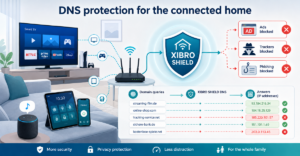
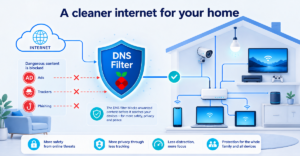
DNS filtering comes in exactly at this point. Suspicious, known ad, tracking or phishing domains can be blocked before the connection is established. This doesn’t replace healthy caution or device updates. But it reduces unwanted connections centrally and unobtrusively in everyday life.
XIBRO SHIELD uses this approach: DNS filtering via a secure WireGuard tunnel and Pi-hole technology. Importantly, XIBRO SHIELD is not a classic service for changing your IP address or country. Your IP address and your connection country stay the same. The focus is on cleaner DNS queries and fewer unwanted connections.
Why protection on the router makes particular sense
Many smart home devices don’t allow additional protection apps to be installed. You can’t just quickly install a security solution on a smart TV, a camera or a fridge. That is exactly why protection at network level is so practical.
If XIBRO SHIELD is set up on a compatible router, devices that don’t run their own app can benefit too. This is particularly helpful in households with many devices: smartphones, tablets, laptops, games consoles, TVs, speakers and IoT devices are then no longer completely on their own in the network.
- fewer known ad and tracking requests
- protection against many known phishing domains
- central management instead of separate work for each device
- more peace in the home network, without changing your everyday life
Who the ZUHAUSE approach suits particularly well
The ZUHAUSE plan from XIBRO SHIELD is aimed at households with many devices and a more connected home. It supports up to 30 devices under fair use and offers unlimited profiles, youth protection, schedules and unlimited whitelist and blacklist entries that can be assigned per profile.
This is particularly practical if children’s devices should be treated differently from work laptops, or if certain services should deliberately be allowed or blocked. Protection for the home network via a compatible router also suits smart home setups well.
XIBRO SHIELD is operated in Germany, stores DNS logs without IP address and only for 91 days, and is designed for ordinary people to use. Not just tech fans with three monitors and a tangle of cables under the desk.
Conclusion: a smart home needs simple control
The more devices are online, the more important a clear, central approach to protection becomes. DNS filtering can’t solve every risk of the digital world. But it helps to reduce many unwanted connections in everyday life. Especially in a smart home, that is a sensible step.
If you want to make your connected home cleaner, calmer and easier to control, take a look at XIBRO SHIELD on xibro.de. Try XIBRO SHIELD – with a 30-day money-back guarantee in case it doesn’t suit you.
NoteXIBRO SHIELD is currently still in the Early Access phase – plans can currently only be activated with an invitation code. Regular sales will start later.